An arc is defined as a homeomorphism from an interval to $X$ (and its range).
Let $x, y \in X$ be any two points in an arc $J$. Then $[x, y]$ denotes the subset of the arc from $x$ to $y$.
We say $J$ is a quasi-arc if there is a number $L \geq 1$ such that $ diam ([x, y]) < L \cdot d(x, y) $ for all $x, y \in J$. This is a classical concept from geometry of metric spaces.
We propose to generalize this notion into that of coarse-arc as follows. $J$ is a $f-$ coarse arc if there exists a function $f : \mathbb{R} \to \mathbb{R} $ such that $ diam ([x, y]) < f (d(x, y)) $ for all $x, y \in J$
Moreover we say a metric space $X$ has an intrinsic curvature $f$ if any arc $J$ in $X$ can be approximated by a $f$-coarse arc and cannot be approximated by any $f’$-coarse arc such that $f’ < f$.
হাইয়া সোফিয়া নির্মাণের অঙ্ক কষেছিলেন দুই গ্রীক গণিতজ্ঞ; অ্যান্থেমিয়াস আর ইসিদোর। সে এক মস্ত অট্যালিকা নির্মাণের অঙ্ক। প্রাচীন দুনিয়ার অষ্টম বিস্ময়। তাকে গড়তে যে বেশ জটিল গণিত কষতে হবে তাতে অবাক হওয়ার কিছু নেই। তবু অবাক হয়েছি। কারণ একটা পিলে চমকানো সমবাহু সপ্তভুজ!
এই রহস্যময় সপ্তভুজের গল্প লিখছি। প্রাচীন জ্যামিতির এই মহাসমারোহ থেকে আমরা নবীনরা হয়ত কিছু শিখতে পারব। মগজের কোষগুলো রসদ পাবে।
ছিলো চার্চ প্রায় ৯০০ বছর। হয়েছিল মসজিদ তারপর ৫০০ বছর। মাঝখানে বছর ৮০ সে ছিলো বিলকুল সেকুলার মিউজিয়াম। ২০২০ সালে সে আবার মসজিদ হয়েছে। এ হেন হাইয়া সোফিয়ায় পা ফেললে বিস্মিত না হয়ে উপায় নেই। বসফরাস সাগরের তীরে সহস্রাব্দ প্রাচীন মহাঅট্যালিকা। আক্ষরিক অর্থে সে পবিত্র জ্ঞানের মন্দির। যীশু খ্রীষ্টের প্রতি সমর্পিত উপাসনালয়। ১১০০০ ক্রীতদাসের হাতে গড়া দেবতার ঘর।
হাইয়া সোফিয়ার একদম কেন্দ্রে আছে এক অদৃশ্য সপ্তভুজ। উইকিপিডিয়ায় সম্ভবত তার উল্লেখ নেই। কিন্তু আধুনিক কিছু গবেষণাপত্রে তাকে খুঁজে পাওয়া যায়। গড়নটা দেখে একটা খটকা লেগেছিল। একটু পড়ে দেখলাম ভাবনাটা মিথ্যা নয়।
অদৃশ্য সপ্তভুজের অস্তিত্ত্ব বুঝতে গেলে একটু মাথা খাটাতে হবে। হাইয়া সোফিয়ার ব্যাসিলিকা (প্রধান সভাঘর)-এর মাঝখানটা একটা লম্বাটে চতুর্ভুজ। সেই চতুর্ভুজের পুব বাহুতে একটা অর্ধগোলাকার অংশ জুড়ে গেছে। এই অংশকে খ্রীষ্টানরা বলেন অ্যাপস (apse)। অর্থোডক্স খ্রীষ্টানরা এ্যাপসের মাঝখানে বেদী গড়তেন। সেই বেদীতে (অলটারে) বলি দেওয়ার রেওয়াজ ছিল। মসজিদ হওয়ার পর অবশ্য সেই অলটারের অস্তিত্ত্ব মুছে গেছে।
প্রাচীন চার্চে ব্যাসিলিকার এই হত গড়ন। অ্যাপসের আকৃতি অর্ধগোলাকার। আগেই বলেছি যে সে সভাগৃহের চতুর্ভুজ মধ্যভাগের সাথে জুড়ে থাকে। এই অর্ধগোলাকার অংশকে যদি মনে মনে পূর্ণবৃত্ত করে দেওয়া যায়, তাহলে তাকে circumscribe করে (অর্থাৎ ঘিরে) থাকবে একটা কাল্পনিক বহুভুজ। এই বহুভুজকে নির্মাণের পর আর চোখে দেখা যায় না। শুধু তার কয়েকটা বাহু বরাবর দেওয়াল নির্মিত হয়। সেসব দেয়ালে বড় বড় জানলা থাকে। নির্মাতারা এমন ভাবে এই জানলাগুলো বানাতেন আর এ্যাপসের দেয়াল এমন এ্যাঙ্গেলে (কোণে) নির্মাণ করতেন যে বিশেষ মাহেন্দ্রক্ষণে সূর্যের আলোকরশ্মি বলির বেদীতে (অলটারে) প্রক্ষিপ্ত হত। সম্ভবত দেবতার ঘরকে আরও অপার্থিব রূপ দেওয়ার জন্য এসব কাণ্ড করা হত।
অন্যান্য চার্চে এই (অদৃশ্য) বহুভুজটা (যে কিনা অ্যাপসকে ঘিরে আছে) সাধারণত পঞ্চভুজ অথবা ষড়ভুজ হত। কারণটা একদম গাণীতিক। কম্পাস আর স্ট্রেটএজ (অর্থাৎ দাগ না দেওয়া রুলার) দিয়ে সমবাহু বহুভুজ যদি আঁকতে চাও তাহলে ত্রিভুজ আঁকতে পারবে, চতুর্ভুজ পারবে, পঞ্চভুজ পারবে, ষড়ভুজ পারবে, কিন্তু সপ্তভুজ পারবে না!
কেন পারবে না?
সেটা বুঝতে মানুষের প্রায় ২০০০ বছর সময় লেগেছে।
বাহুর দৈর্ঘ্য যদি constructible সংখ্যা হয়, তবেই তাকে কম্পাস আর স্ট্রেটএজ দিয়ে আঁকা সম্ভব। কাকে বলে কন্সট্রাকটিবল সংখ্যা? যদি তুমি সংখ্যাটাকে সসীম গোটা সংখ্যার (finite number of integer) যোগ, বিয়োগ, গুণ, ভাগ আর বর্গমুল দিয়ে লিখতে পারো তবেই সে হবে constructible। প্রমাণ করা সম্ভব যে একমাত্র এই ধরণের দৈর্ঘ্যকেই কম্পাস আর স্ট্রেটএজ দিয়ে আঁকা যায়। যদিচ এটা প্রমাণ করতে মানুষের হাজার হাজার বছর সময় লেগেছে। সমবাহু সপ্তভুজের বাহুর দৈর্ঘ্য কন্সট্রাক্টিবল নয়। তাই তাকে কম্পাস আর স্ট্রেটএজ দিয়ে আঁকা যায় না।
অতএব বুঝতেই পারছ যে এ্যাপসের বাইরে যে অদৃশ্য সমবাহু সপ্তভুজ এ্যান্থেনিয়াম আর ইসেদোর গড়েছিলেন তার নিঁখুত নির্মাণ কম্পাস আর স্ট্রেটএজ দিয়ে সম্ভব হত না। তাহলে কি ভাবে অসম্ভবকে সম্ভব করেছিলেন তারা?
জ্যামিতিতে আরেক রকমের (নির্মাণ) কন্সট্রাকশন হয়। এই কনস্ট্রাকশনটার উদ্ভাবক সম্ভবত আর্কিমিডিস। একে বলে neusis construction। এই পদ্ধতিতে সমবাহু সপ্তভুজ আঁকা যায়। হাইয়া সোফিয়ার স্থপতিরা এই পদ্ধতি জানতেন বলেই মনে হয়। এই কায়দায় অনেক ভাবেই সমবাহু সপ্তভুজ আঁকা যায়। আধুনিক কালে জেভিড জনসন লিইস্ক একটা কায়দা বার করেছেন। এই ভদ্রলোক শখের গণিতজ্ঞ। প্রথম জীবনে কমিক্স আঁকতেন, ছোটদের জন্য লিখতেন। পরে গণিতে আগ্রহ জন্মায়। গণিত এবং চিত্রকলা নিয়ে এসারের মত এঁর কাজও প্রখ্যাত।
জনসনের কায়দাটা খানিকটা এরকম (ছবির সাথে মিলিয়ে নিতে পারো) –
রুলারের ওপর দুটো দাগ দিয়ে নাও। দাগ দুটো একে অপরের ১ ইঞ্চি তফাতে থাকবে।
কাগজে একটা রেখাংশ, AB, আঁকো (১ ইঞ্চি দৈর্ঘ্য)। তার ওপরে AC লম্ব আঁকো। তারপর BC জুড়ে দাও। এবার B-কে কেন্দ্র আর BC-কে রেডিয়াস করে একটা বৃত্ত আঁকো। AB-র কেন্দ্রবিন্দুতে AB-র ওপর একটা লম্ব L আঁকো।
এবার নিউসিস করতে হবে। অর্থাৎ এক ইঞ্চি সমান একটা দৈর্ঘ্য-কে খাপে খাপে বসাতে হবে। প্রথমে A বিন্দুর ওপর স্কেলটা লম্ব ভাবে বসাও। তারপর A বিন্দুর দিকে রুলারটা হাত দিয়ে চেপে রেখে স্কেলের অপর মুখটা ঘোরাতে থাকো। এমন একটা জায়গা অবধি ঘোরাও যাতে স্কেলের মধ্যে এক ইঞ্চি মাপটার একটা ডগা L-এর ওপর থাকে আর একটা ডগা ঠিক বৃত্তের ওপর। যে ডগাটা L- কে ছেদ করল তার নাম দাও D। এবার ADB-র ওপর একটা বৃত্ত আঁকো আর AB-কে একটা বাহু করে সমবাহু সপ্তভুজ এঁকে ফেলো।
হাইয়া সোফিয়ার দুই স্থপতি সম্ভবত এরকম কোনো একটা পদ্ধতি জানতেন। তাই তারা সমবাহু সপ্তভুজ গড়তে পেরেছিলেন। ফলাফলটা হয়েছিলো দৃশ্যত অলৌকিক।
পঁচিশে ডিসেম্বরে, দিনমানের তৃতীয় প্রহরে, সূর্যের আলো ঠিক হাইয়া সোফিয়ার অলটারে এসে পড়ত। এই সময়টা খ্রীষ্টানদের মতে একটা পবিত্র কালখন্ড। বলে রাখা ভালো, প্রাচীনকালে ঘন্টা মিনিটের হিসেবটা একটু অন্যরকম ছিলো। দিন সবসময়েই বারো ঘন্টার, রাতও বারো ঘন্টার। অতএব ঋতু অনুসারে ঘন্টার মাপ ছোটবড় হত। পঁচিশে ডিসেম্বরের প্রবল শীতে প্রভাতের তৃতীয় ঘন্টা ইস্তানবুলে ঠিক কখন হবে, সে সময় সূর্যের আলো কোন এ্যাঙ্গেলে পড়বে, তার একটা জটিল হিসেব কষে নির্মাতার এ্যাপস বানিয়েছিলেন। সপ্তভুজ গড়তে হয়েছিল সেই কারণেই।
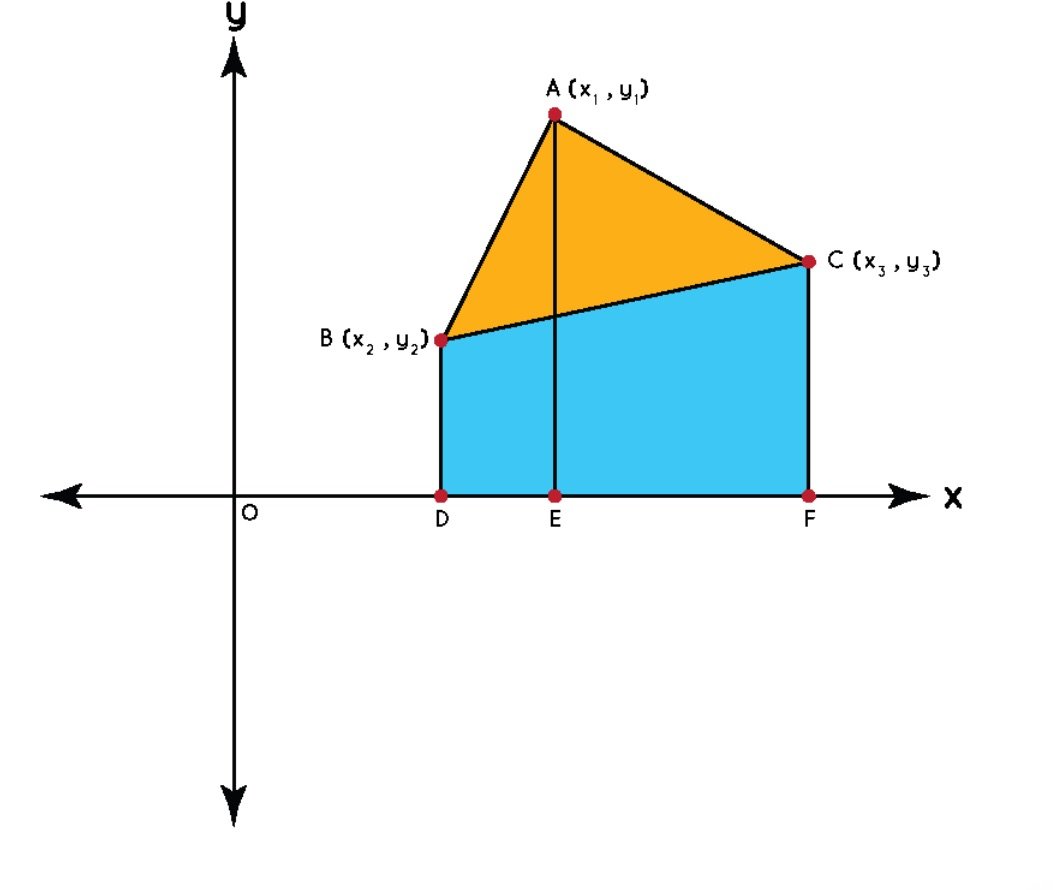
ব্যাপারটা খোলসা করা যাক। প্রথমে একটা ত্রিভুজ এঁকে ফেলো গ্রাফ পেপারে। প্রতিটা বিন্দুর একটা করে coordinate থাকবে।
ত্রিভুজ এঁকেছি গ্রাফ পেপারে
ত্রিভুজটার ক্ষেত্রফলের একটা ফর্মুলা খোঁজা যাক। এমনিতে ত্রিভুজের ক্ষেত্রফল হচ্ছে
$$ \frac{1}{2} \times base \times height $$
কিন্তু আমরা ঠিক তেমন ফর্মুলা চাইছি না। আমরা কোনবিন্দুদের coordinate দিয়ে ক্ষেত্রফল লিখে ফেলতে চাই।
তিনটে কোন থেকে x-axis-এর ওপক লম্ব (perpendicular) এঁকে নাও। সহসা তিনটে ট্রাপিজিয়াম আবির্ভুত হবে।
দুটো ট্রাপিজিয়াম যোগ করে একটা বিয়োগ করলে, ত্রিভুজের ক্ষেত্রফল পাওয়া যাবে।
$$ ABDE + ACFE – BCFD = \Delta ABC $$
Trapezium -এর ক্ষেত্রফলের সূত্র বেশ সোজা। সমান্তরাল দুটো বাহু যোগ করো। যোগফল-কে সমান্তরাল বাহুর দুরত্ত্ব দিয়ে গুণ করো। শেষমেশ ২ দিয়ে ভাগ করে দাও। ব্যাস হয়ে গেলো।
$$ \frac{1}{2} \times \textrm{(sum of parallel sides)} $$
$$ \times \textrm{(distance between parallel sides)} $$
(এই সূত্রটা ওই ত্রিভুজের ক্ষেত্রফলের সূত্র থেকেই পাওয়া যায়। Trapezium-কে দুই টুকরো করে নাও যে কোনো diagonal এঁকে। তারপর সেই ত্রিভুজ টুকরো দুটোর ক্ষেত্রফল যোগ করো।)
Coordinate দিয়ে ত্রিভুজের ক্ষেত্রফল লিখতে গেলে, তোমায় Trapezium-কে ছুঁয়ে আসতে হবে। এবার প্রশ্ন হলো এই তিনটে ট্রাপিজিয়াম কখন parallelogram হতে পারে? মনে মনে ভাবো যে BC হচ্ছে x-axis-এর সমান্তরাল। তা হলে BCFD হয়ে যাবে paralleogram। বাকি দুটো Trapezium কিন্তু parallogram হবে না। এক কাজ করো। A বিন্দুকে ক্রমশ BC-র দিকে নামিয়ে আনো। দেখবে ABDE আর ACFE ক্রমশ parallelogram হয়ে উঠছে। যেই না A বিন্দুটা BC স্পর্শ করবে, তারা parallelogram হয়ে যাবে। ত্রিভুজের ক্ষেত্রফল হয়ে যাবে ০।
তাহলে এভাবে ভাবতে পারো যে trapezium দুটোর parallelogram না হওয়ার কারণ হলো A বিন্দুর মাথা উঁচিয়ে থাকা। সে মাথা নামালেই সব সমান্তরাল হয়ে যাবে।
মনে করো তোমার কাছে চল্লিশটা ইঁট আছে। প্রতিটি ইঁট এক ফুট লম্বা। তুমি একটা rectangle বানাতে চাও। কিন্তু যেমন তেমন একটা rectangle বানালে হবে না। যে চতুর্ভুজটা বানাবে তার ক্ষেত্রফল যতটা সম্ভব বড় হতে হবে।
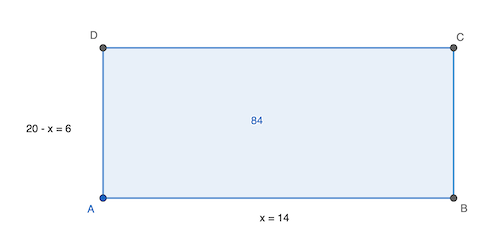
ধরো লম্বা লম্বি ষোলো ফুট ইঁট বসালে। আড়াআড়ি বসল চার ফুট ইঁট। ক্ষেত্রফল হলো চার – ষোলো চৌষট্টি। কিন্তু যদি লম্বা লম্বি চোদ্দ ফুট ইঁট বসাও আর আড়াআড়ি ছয় ফুট করে, তাহলে ক্ষেত্রফল হবে ছয় গুণ চোদ্দো সমান চুরাশি! মানে ক্ষেত্রফল বেড়ে গেল।
ঠিক কি রকমের চতুর্ভুজ বানালে সবচে বেশি ক্ষেত্রফল ঘিরে ফেলা যায়? এই সত্যে কিন্তু অঙ্ক কষে পৌঁছানো যেতে পারে।
ধরা যাক রেকট্যাঙ্গেলটার একটা বাহু হলো x ফুট। তবে অন্য বাহু হবে 20 – x ফুট। ক্ষেত্রফল হবে $$ x(20-x) = 20x – x^2 $$
এই এক্সপ্রেশনটা আমরা একটু ঘুরিয়ে লিখব।
$$ 10^2 – (10^2 – 2 \times 10 \times x + x^2) $$
এবার কিন্তু আমরা সত্যের কাছাকাছি। ক্ষেত্রফল হচ্ছে।
$$ 100 – (10 – x)^2 $$
এই সংখ্যাটা সবসময় ১০০-র থেকে কম হবে কারণ আমরা ১০০-র থেকে একটা বর্গ সংখ্যা বিয়োগ করছি। বর্গ সংখ্যা সর্বদা পজিটিভ হয়। অতএব আমরা ১০০-র থেকে কোনো একটা পজিটিভ সংখ্যা বিয়োগ করছি। অতএব ক্ষেত্রফল ১০০-র কিছুটা কম হবে।
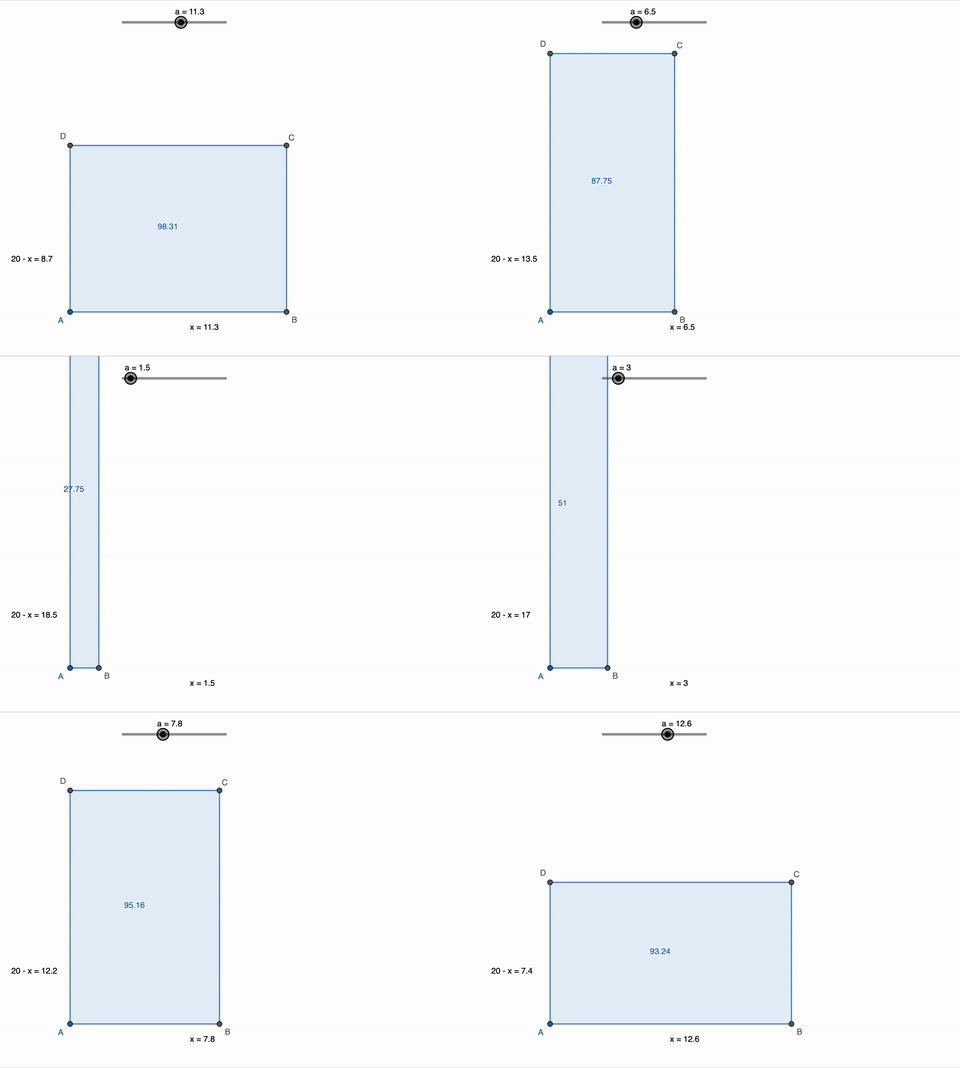
আমরা যেহেতু ক্ষেত্রফলের সর্বোচ্চ সম্ভাব্য মান চাই, অতএব, \( (10-x)^2 \) যতটা পারা যায় কমিয়ে ফেলা যাক। ভেবে দেখো x = 10 হলে \( (10-x)^2 \) মান সবচেয়ে কম হবে (০ হয়ে যাবে)। x = 10 যেই না বসিয়েছো, রেক্ট্যাঙ্গেলটা বেমালুম স্কোয়ার হয়ে গেছে!
অর্থাৎ এক গুচ্ছ rectangle-কে এবার ক্রমশ square হয়ে উঠতে দেখা যাচ্ছে মানসচক্ষে। যত আমরা ক্ষেত্রফল বাড়াচ্ছি rectangle-এর square-পনা বেড়ে চলেছে। শেষমেশ সে স্কোয়ার হয়েই যাচ্ছে। সেখানেই তার মুক্তি। সেখানেই তার ক্ষেত্রফলের উর্ধ সীমা।
I sometimes create small problems (mostly at pre-college level), to have fun. Here are three recent ones. Readers may give it a try or point out issues with problem-statement or indicate that it is trivial.
Please note that some version of these problems may exist somewhere as there is a tendency of familiar ideas to echo through the brain. May be I have read something like this somewhere in the past. At any rate, this is just some musing for fun.
Problem 1
A connected, directed graph is called a ‘Calcutta Graph’ if degree of every vertex is 3, each vertex has exactly two incoming edges and one outgoing edge.
Suppose G is a Calcutta Graph with n vertices. Then at most how many directed circuits can G have?
Problem 2
A $n \times n$ grid is made up of $n^2$ squares. In each square you are allowed to draw one diagonal. If $k$ diagonals line-up, end-to-end, then they make a path of length $k$. The figure below shows a $4 \times 4$ grid with a path of length $6$.
Find the maximum number of paths of length $2n$ in a $n \times n$ grid.
Problem 3
Suppose $n$ circles and $n$ (infinite) lines are drawn in the plane such that
No three lines pass through a single point
No three circles pass through a single point
Every pair of circles intersect each other at two distinct points
Every pair of lines intersect each other at one point
Every line cuts every circle at two distinct points.
The graduate-school days are zooming away quickly from my life. It seems that the space of human memory is hyperbolic in nature. Things get thin and small at an exponential rate. I defended my thesis in July 2020 and reached India in August of the same year. The pandemic was in full swing. It was a conscious choice to return to my aging family who needed support.
Almost all of 2021 was spent on the paper that Chris and I were working on. It is an extension of the results in my doctoral thesis. We showed that connected boundary of a relatively hyperbolic group is locally connected. This removed some of the tameness restrictions that Bowditch’s theorem has on the peripheral subgroups. At the end of 2021, my advisor suggested that I should work on some projects alone.
For a few days, I felt like a radarless ship in the ocean of mathematics. Since I was not associated with any university at the time, research had to be a solo adventure. I decided to build a small research group at Cheenta. It is the organisation that I developed from scratch since 2010.
Cheenta was conceived as a training school for math olympiads for school students. Subsequently we have also accepted college students for university level programs. We already have a strong alumni and student base spread all around the world. I could easily get a few people who became curious about geometric group theory.
We started meeting weekly. In order to keep a psychological leverage, I put the meeting time on Tuesdays at 10:30 PM IST or 11 AM CST. In graduate school, that was the time when I met my advisor weekly. My brain-clock responded to this procedure and a group of 7 students was assembled for weekly adventures in geometric group theory.
2022 was also productive. I managed to prove a small theorem related to Dehn fillings and connectedness of Bowditch boundary. The entire team participated in a translation project of the famous green book by Ghys and Harpe from French to English. I also started collaborating with Arka Banerjee on another problem related to embedding of hyperbolic plane in relatively hyperbolic groups.
I hope 2023 will be productive. I want to understand how small cancellation theory, and splittings of relatively hyperbolic groups interact. It could be a powerful source of examples in group theory. Another area that interests me is the theory of hierarchically hyperbolic groups and spaces.
There are a few obstacles for my research activities. Books and journals are not easily available outside the university system. Access to conferences is hard. I was invited to speak at a conference in Ohio (to be held in April). However due to VISA and funding issues I was forced to decline the offer. There are few positive ends as well. My work at Cheenta allows me to have flexible work-hours and financial security. It also helps me to stay with my family at home.
Lets hope 2023 will be productive with what I have.
This is an ongoing survey of olympiad problems. Source material is INMO, USAMO and IMO. The goal is to indicate key ideas involved in the proof.
USAMO 2010 Problem 1
Let $A X Y Z B$ be a convex pentagon inscribed in a semicircle of diameter $A B$. Denote by $P, Q, R, S$ the feet of the perpendiculars from $Y$ onto lines $A X, B X$, $A Z, B Z$, respectively. Prove that the acute angle formed by lines $P Q$ and $R S$ is half the size of $\angle X O Z$, where $O$ is the midpoint of segment $A B$.
Key Concepts
Angle at centre is twice the angle at circumference
External angle in a cyclic quadrilateral is equal to the interior opposite angle
Simson Line
Cyclic Pentagon
Idea of Proof
If we use Simson line (feet of perpendiculars from a point in the circumference, in this case $Y$, to three sides of a triangle (in this case $\Delta A X B$ and $\Delta A Z B$) are collinear), then we immediately conclude that $PQ$ and $RS$ meet at a point $M$ on the diameter $AB$. Here is part of the picture.
Next notice that we have a cyclic pentagon $A P Y R M$. Now angle chasing shows $\angle Z M Y = \angle Z A Y$ and so on. This proof is suggested in Evan Chen’s notes.
Alternatively we may do angle chasing. Here the key idea is to show $M C Y D$ is a cyclic quadrilateral.
INMO 2014 Problem 5
In an acute-angled triangle $A B C$, a point $D$ lies on the segment $B C$. Let $O_1, O_2$ denote the circumcentres of triangles $A B D$ and $A C D$, respectively. Prove that the line joining the circumcentre of triangle $A B C$ and the orthocentre of triangle $O_1 O_2 D$ is parallel to $B C$.
Key Concepts
Similarity of triangles
Cyclic pentagon
Angles at orthocenter
Angle at the centre of a circle is twice the angle at circumference
Idea of Proof
Notice the $H$ and $O$ are orthocenter and circumcenter of two different triangles $\Delta O_1 O_2 D$ and $\Delta ABC$. One recurring theme in geometry is to bind special points in different triangles via cyclic pentagons. A major step in this problem is to identify $A O_1 H O O_2$ as a cyclic pentagon. In fact notice that $\Delta A O_1 O_2$ is similar to $\Delta A B C$ is similar to $O_1 O_2 D$.
INMO 2016 Problem 1
Let \( ABC \) be triangle in which \( AB = AC \). Suppose the orthocentre of the triangle lies on the in-circle. Find the ratio \( \frac{AB}{BC} \).
Idea of proof
Suppose \( H \) is the orthocenter and \( I \) is the incenter. Suppose \(AD\) is the perpendicular cum angle bisector passing through \( H \) and \( I\) meeting \( BC \) at \( D \).
Then \( \tan \frac{B}{2} = \frac{r}{BD} \), the inradius.
We can also show \( \tan \frac{A}{2} = \frac{2r}{BD} \).
Since \( A = \pi – 2B \), doing some trigonometry we obtain the value of \( \cos B \). The final answer is equivalent to \( \frac{1}{2 \cos B } \) which turns out to be \( \frac {3}{4} \).
INMO 2014 Problem 1
In a triangle \( ABC \), let \(D\) be a point on the segment \(BC\) such that \(AB + BD = AC + CD\). Suppose that the points \(B, C\) and the centroids of triangles \(ABD\) and \(ACD\) lie on a circle. Prove that \(AB = AC\).
Key Concepts
Parallel lines divide sides in equal ratios
Apollonious Theorem
Triangular Inequality
Centroid divides median in \( \frac{2}{1} \) ratio.
Proof Idea
Suppose \( T \) is the midpoint of \(AD\). If \(G_1\) and \( G_2 \) are the two medians, we show that \(G_1 G_2\) is parallel to \( BC \).
Then \(B G_1 G_2 C\) is a cyclic trapezium. This implies \(BT = CT\)
Now apply Apollonious theorem to deduce that \(AB^2 + BD^2 = AC^2 + CD^2\)
Finally notice that \(AB + BD = AC + CD\) from given hypothesis. Transposing we get \(AB^2 – AC^2 = CD^2 – BD^2\). Hence either \(CD – BD\) cancels out with \(AB – AC \) provided both the non-zero, or we have \(AB + AC = BD + CD\). The second case is impossible as it violates triangular inequality. Hence the first case holds.